How to Train a Great Pyrenees: The Complete Guide
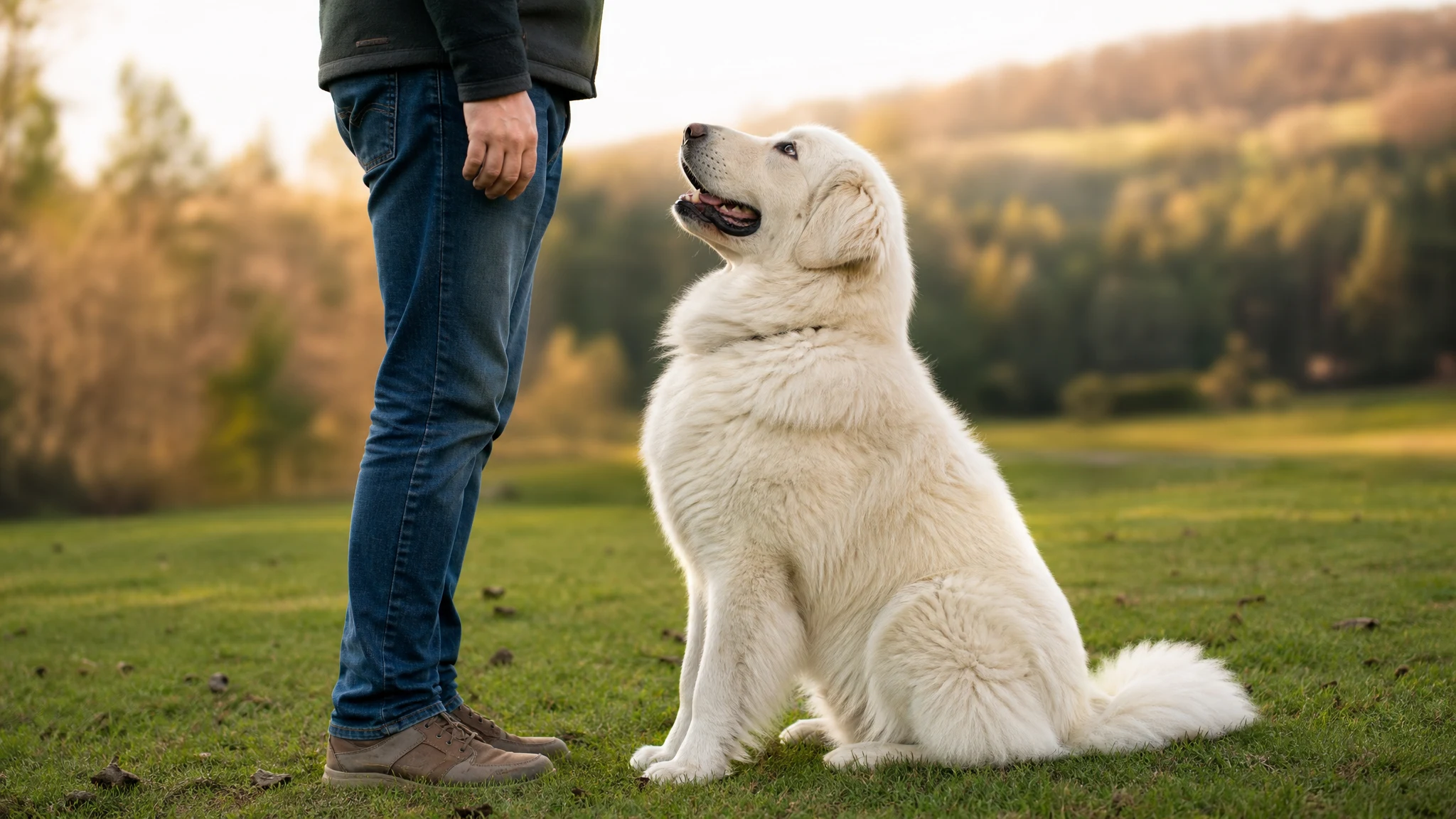
General training information. Every dog is an individual; for health or behavior concerns, see your veterinarian.
Great Pyrenees training starts with a simple idea. This is a livestock guardian, not a dog built to hang on your every cue. Once you understand that, the breed's habits start to make sense, and your training plan gets a lot easier to build.
This guide covers how to train a Great Pyrenees from the first weeks home to adulthood. It explains what the breed was developed to do, how the training stages unfold, which rewards work, and which problems to plan for early. The Great Pyrenees is a breed I love, and it is also one that rewards patience more than pressure.
Every dog is an individual. What follows describes tendencies reported by breed sources, not promises about your dog.
Key Takeaways
- The breed was developed in the Pyrenees Mountains to guard livestock, so independence and alertness are part of the design.
- Hill's Pet rates trainability at 2 out of 5 (Somewhat Difficult). Plan for patience, short sessions and a lot of repetition.
- The Great Pyrenees Club of America (GPCA), as quoted by PetMD, recommends obedience classes for first-time owners.
- Use humane, reward-based methods only. Force and dominance tactics work against a dog that already thinks for itself.
- Secure fencing matters. The breed tends to roam.
- Expect barking, very heavy shedding and heat sensitivity. Plan for all three from day one.
- Take health questions, including bloat and joint concerns, to your veterinarian.
Table of Contents
- What the Great Pyrenees Was Bred For
- Training Stages from Puppy to Adult
- Motivation That Works for This Breed
- Core Skills to Teach
- Exercise and Mental Work
- Challenges to Plan For
- Putting Together Your Training Plan
- Sources
What the Great Pyrenees Was Bred For and How It Shapes Training
Every good training plan begins with the dog's job history. For this breed, that history is livestock guarding.
A guardian from the mountains
PetMD reports that the Great Pyrenees comes from the Pyrenees Mountains between Spain and France, where it was developed to guard livestock. Hill's Pet describes the original purpose as guarding livestock from predators on mountain pastures. Hill's also places the breed in the Working Group.
Think about what that job requires. A dog guarding sheep on a mountainside can't wait for instructions. It has to watch, decide and act on its own. That is the background behind the traits owners notice at home.
Temperament in the sources
PetMD, quoting the Great Pyrenees Club of America, describes the breed as calm, independent and alert. The United Kennel Club (UKC) breed standard mentions innate gentleness, independence and a sense of authority.
Put those words together and you get a dog that is often gentle and steady, but also one that may not see why it should drop what it is doing because you said a word. Independence is the trait that shapes training most.
What this means for you
Hill's rates the breed's trainability at 2 on a 1 to 5 scale, which it labels Somewhat Difficult. PetMD, citing the GPCA, says training can be challenging because of that independence. Those ratings are Hill's own, not the American Kennel Club's.
It helps to read that rating correctly. It does not say the dog is unintelligent. It says the dog may not be eager to work for approval alone. That points you toward a clear approach:
- Make cooperation worth the dog's while.
- Keep sessions short and calm.
- Start early and stay consistent.
- Manage the environment so the dog can't practice the habits you don't want.
Why humane methods matter even more here
Good training for any dog follows the position of the American Veterinary Society of Animal Behavior (AVSAB), which supports reward-based methods. With a self-directed breed, harsh methods carry extra cost. A dog that is bred to make independent decisions under pressure tends to dig in, shut down or lose trust when it is corrected roughly.
Skip shock, prong and choke collars. Skip alpha rolls, scruffing and anything built on dominating the dog. Patience and rewards give you a better relationship and clearer results.
Training Stages from Puppy to Adult
The breed matures slowly. Petful notes that a Great Pyrenees reaches near adult height around 18 months, while chest, muscle, coat and mental maturity continue into the second or third year. Your training plan should expect that long runway.
Stage 1: The first weeks home
Start with routine, not drills. Your goals in the first weeks are simple:
- Set up a predictable schedule for meals, potty breaks, naps and play.
- Teach the puppy its name with a treat each time it looks at you.
- Begin house training with frequent trips outside and quick rewards for success.
- Introduce a crate or a safe resting area with something good inside.
- Handle paws, ears, mouth and coat gently so grooming and vet visits feel normal.
Handling practice matters for this breed because of the coat. You will spend plenty of time brushing, so teach the puppy early that being groomed pays off.
Stage 2: Socialization window
Hill's says the Great Pyrenees is gentle and protective with children when socialized as a puppy, and recommends supervision. Hill's also says the breed can get along with other pets, including livestock, with proper socialization and introductions. PetMD and the GPCA both point to early socialization as a priority.
Good socialization means many calm, positive experiences, not overwhelming ones. Aim for:
- Meeting a range of friendly, calm people, including visitors who come to the door.
- Hearing everyday sounds such as the vacuum, doorbell and traffic at a low level, paired with treats.
- Walking on different surfaces and seeing different places.
- Controlled introductions to other animals your dog will live with.
Ask your veterinarian which places are safe for a puppy before vaccinations are complete. Don't push a nervous puppy forward. Let it watch from a distance and reward calm behavior.
Stage 3: Foundation manners (roughly the first year)
This is when you build the basic skills in the next section. Keep each session to a few minutes. Several short sessions a day beat one long one, especially for a dog that tends to lose interest when work gets repetitive.
Be careful with growth and physical stress. Petful advises avoiding repetitive high-impact exercise, forced running and frequent jumps from vehicles while the puppy is growing. It also advises large-breed puppy food and says not to add calcium or supplements to speed growth. Ask your veterinarian about feeding and about what exercise suits your puppy's age.
Stage 4: The teenage months
Many owners find adolescence the hardest stretch with any dog. A dog that knew a cue in the kitchen may act as if it has never heard it in the yard. This is normal learning behavior, not stubbornness you must punish.
Go back a step. Practice in easier places, raise the reward value and keep sessions short. Keep fencing and leash habits tight, because the roaming tendency noted by Hill's can show up as confidence grows.
Stage 5: Maturity and adulthood
As the dog fills out in its second and third year, you will see what kind of adult you have. Keep practicing. Training does not end at a certain age, and a mature guardian dog still benefits from regular refreshers, clear rules and a steady routine.
Motivation That Works for This Breed
With a dog that does not live to please you, motivation is the heart of training. The aim is to make good choices the most rewarding choices.
Find what your dog values
Every dog differs, so test a few options and see which ones your dog works for:
- Small, soft food treats, kept tiny so they don't spoil meals.
- Part of the daily meal, used as training rewards.
- Calm praise and gentle petting, if your dog enjoys them.
- Access to something the dog wants, such as a sniff break or a trip outside.
Watch your dog's weight, since treats count toward daily food. Your veterinarian can advise on amounts. I won't give feeding quantities here.
Reward quickly and clearly
Mark the exact moment the dog does the right thing with a word like "yes," then deliver the reward. Timing teaches the dog which action earned it. Keep your cues short and say them once. Repeating a cue five times teaches the dog that the first four don't count.
Keep sessions short and end on a win
An independent dog can walk away from boring work. Stop before that happens. Finish with something easy the dog gets right, then release it to enjoy a reward.
Be consistent as a household
Everyone in the home should use the same cues and the same rules. If one person lets the dog on the couch and another doesn't, the dog learns that rules are optional. GPCA guidance, as relayed by PetMD, calls for patient, consistent positive training, and consistency starts at home.
Manage instead of confront
Some problems are easier to prevent than to correct. If the dog slips out of the yard, fix the fence. If it barks at the window all evening, change what it can see. Management removes chances to rehearse unwanted habits while you build the right ones.
Core Skills to Teach
These skills give you control and safety. They also make daily life with a large dog easier.
Name response and attention
Say the name, reward eye contact. This is the base for everything else. Practice in quiet rooms first, then add distractions slowly.
Sit, down and settle
Teach sit and down with treat lures, then fade the lure. A solid "settle" on a mat is useful for a calm breed. Reward the dog for lying quietly, and gradually extend the time.
Loose-leash walking
A dog that weighs a lot can't be allowed to pull. Hill's lists the weight range as 85 to 120 pounds with males larger, while PetMD gives about 85 pounds for females and over 100 for males. The sources differ, but either way you will be handling a big, strong dog.
Reward the dog for walking beside you with a slack leash. Stop moving when the leash tightens and move on when it loosens. A well-fitted harness or flat collar is a humane choice. Avoid prong, choke and shock tools.
Recall
Recall is the cue many owners of independent breeds struggle with, so go slowly. Practice indoors, then in a fenced space, and always on a long line outside secure areas. Use a high-value reward and never call the dog to scold it.
Because Hill's notes the breed's tendency to roam, treat off-leash time in open areas with great caution. A reliable recall takes long practice, and secure fencing is still the safer choice.
Leave it and drop it
These cues keep a dog away from things it shouldn't have. Trade the dog something better for what it holds, and praise the swap.
Calm greetings
A large dog jumping on guests is a problem. Reward four paws on the floor, and ask visitors to ignore the dog until it settles. Because the breed is protective, keep early greetings calm and supervised, particularly with children.
Handling and grooming cooperation
Teach the dog to stand still for brushing, nail care and exams. Pair each step with a treat. Hill's rates shedding at 5 out of 5 (Very High Shedding), year-round and heavier in spring and fall, so you will be grooming often. Cooperative grooming saves time and stress.
Classes and canine activities
PetMD, citing the GPCA, recommends obedience classes for first-time owners. A class offers outside guidance, practice around other dogs and a chance to ask questions. Look for an instructor who uses reward-based methods. According to the GPCA, the breed also takes part in obedience trials and Canine Good Citizen tests, and Hill's suggests agility.
Exercise and Mental Work
A guardian breed does not need the same output as a herding or sporting dog, but it still needs a plan.
How much activity
Hill's rates the breed's energy level at 2 out of 5 (Low Energy) and lists 20 to 40 minutes of activity a day. The same source and PetMD describe moderate daily exercise such as gentle walks or hiking. These are general figures. Your veterinarian can tell you what suits your dog's age and health.
Remember the growth cautions from earlier. For a puppy, favor gentle play and short walks over forced running or repetitive jumping.
Secure space matters more than distance
Because the breed tends to roam, a safe, tall and sturdy fence matters as much as the walk itself. Check the fence line regularly. Don't rely on an invisible barrier or on the dog's good manners.
Heat and weather
Hill's lists heat sensitivity among the breed's issues. Exercise in the cooler parts of the day, provide shade and fresh water, and ask your veterinarian about warm-weather precautions.
Mental work
A dog bred to watch and think often does well with tasks that use its mind. Consider:
- Food puzzles and snuffle mats at meal times.
- Short training games, such as "find it" with treats scattered in the yard.
- Learning new cues or simple tricks in brief sessions.
- Calm sniff walks where the dog sets the pace.
- Classes in obedience, Canine Good Citizen preparation or agility, as noted above.
For a family that lives on a farm or ranch, the GPCA lists livestock guarding as a continuing job for the breed. If you plan to use your dog that way, seek out the GPCA or an experienced guardian dog owner for guidance on introductions and supervision. I can't offer specifics beyond what the sources say, so check with the club.
Challenges to Plan For
Hill's and PetMD name several known challenges: independence that makes obedience harder, a strong instinct to bark, roaming and fence testing, very heavy shedding, bloat risk and heat sensitivity. Here is how to plan for each.
Independence
Expect a dog that considers a cue before it acts. Don't read that as defiance. Make rewards worthwhile, keep training short and stay patient. If you feel stuck, a reward-based trainer or class can help.
Barking
Hill's rates barking at 3 out of 5 (Moderately Vocal) and describes a strong instinct to bark as an alert. That instinct comes from the dog's guarding work. You can shape it, but you probably can't remove it.
- Thank the dog for alerting once, then call it away and reward quiet.
- Teach a "quiet" cue by rewarding the pause between barks.
- Limit what the dog can see or hear from windows and fences when you can.
- Make sure the dog's needs are met, since bored or lonely dogs often bark more.
Tell your neighbors you are working on it, and check any local noise rules with your city or county.
Roaming and fence testing
Build a strong, secure fence and inspect it. Leash the dog in unfenced areas. Don't leave a dog unsupervised outdoors where it can wander. Microchipping and ID tags are sensible backups, and your veterinarian can explain the options.
Heavy shedding and coat care
Hill's rates shedding at 5 out of 5 and also lists matting among the coat concerns. Brush regularly, more during spring and fall, and teach the dog to accept it. Ask a groomer or your veterinarian about coat care that suits your dog.
Bloat risk
PetMD lists gastric dilatation and volvulus, commonly called bloat, among the breed's health concerns. Bloat is an emergency. Talk to your veterinarian now about the signs, about feeding routines and about what to do if you see trouble. Don't wait to learn this in a crisis.
Other health issues
PetMD and Hill's list hip and elbow dysplasia, patellar luxation, eye conditions and neuronal degeneration, among others. Hill's adds osteosarcoma and Addison's disease. PetMD gives a life expectancy of 10 to 12 years. These are conditions to discuss with your veterinarian, not to diagnose yourself.
If you are choosing a puppy, ask the breeder about health screening. Embrace Pet Insurance, summarizing the Canine Health Information Center (CHIC) program, says CHIC requires OFA hip and patella certification, and lists OFA elbows, cardiac and thyroid testing as recommended. Confirm the current requirements on the Orthopedic Foundation for Animals (OFA) website and with the Great Pyrenees Club of America.
Pain and training
If a dog suddenly stops responding, resists being touched or seems reluctant to move, don't assume it is stubborn. Pain can change behavior. Have your veterinarian check it first.
Putting Together Your Training Plan
Now put the pieces together. Here is a simple framework you can adjust to your household.
A weekly rhythm
- Daily: two or three short training sessions, plus routine walks and play.
- Daily: a few minutes of grooming and handling practice.
- Weekly: one new skill or a new location for practice.
- Weekly: a fence and gear check.
- Monthly: review progress, then raise the difficulty or step back as needed.
A quick reference table
| Trait | What the sources say | Training response |
|---|---|---|
| Independence | Trainability 2 of 5 (Hill's); independent (GPCA via PetMD) | Short, rewarding, consistent sessions |
| Barking | 3 of 5, Moderately Vocal (Hill's) | Reward quiet, manage what the dog sees |
| Energy | 2 of 5, Low Energy; 20 to 40 minutes a day (Hill's) | Gentle walks, mental work |
| Roaming | Tends to roam (Hill's) | Secure fencing, leash outside |
| Shedding | 5 of 5, Very High (Hill's) | Regular brushing, handling practice |
| Growth | Near adult height around 18 months (Petful) | Avoid high-impact stress while growing |
When to get help
Ask for outside help if you see growling, snapping, severe fear, or behavior that is getting worse. Start with your veterinarian to rule out a medical cause. Then look for a trainer who uses reward-based methods and ask what methods they use before you book. The GPCA is also a sensible place to ask for breed-informed advice.
Set realistic expectations
You are unlikely to end up with a dog that snaps to attention at every cue, and that is fine. A well-trained Great Pyrenees is usually calm, safe at home, easy to handle and manageable on walks. Aim for a steady, trusting partner. Progress comes slowly with this breed, and that slow, steady work is part of the charm.