Crate Training a Great Pyrenees and Preventing Separation Anxiety
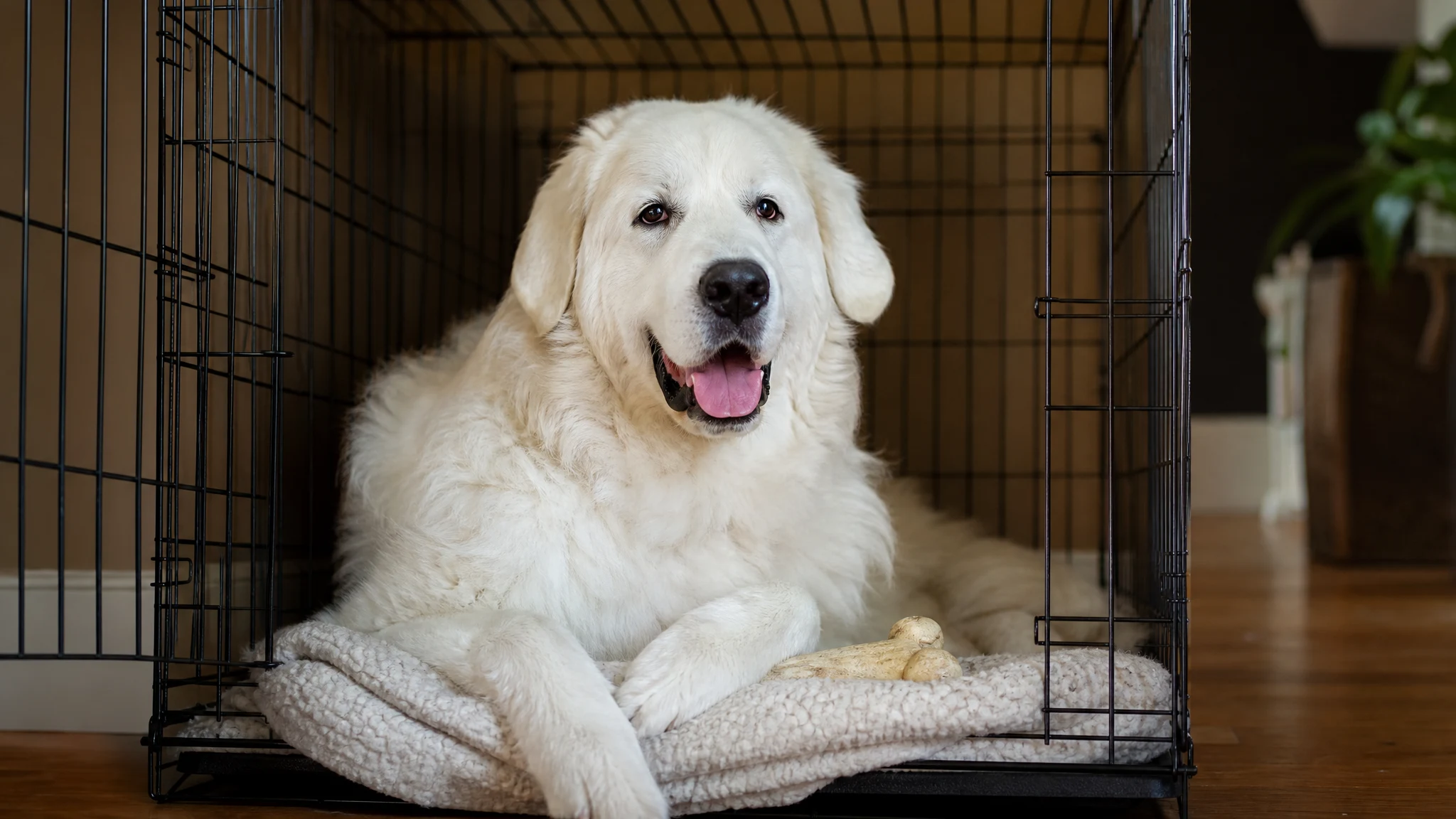
General training information. Every dog is an individual; for health or behavior concerns, see your veterinarian.
A Great Pyrenees was developed to guard livestock on mountain pastures, according to Hill's Pet. That job asked for a calm, independent dog that stays alert and makes its own decisions. It did not ask for a dog that lies quietly in a small box while the family is out.
That is why Great Pyrenees crate training takes a little more patience than it does with some breeds. The good news is that a crate can become a comfortable resting spot, and gradual practice may help your dog handle time alone more calmly. This guide walks through the whole process, from picking a crate to building alone time.
Why Crate Training Suits This Breed, and Where It Gets Tricky
The Great Pyrenees Club of America (GPCA), as quoted by PetMD, describes the breed as calm, independent and alert. Hill's Pet rates trainability at 2 out of 5 (somewhat difficult) and barking at 3 out of 5 (moderately vocal). These are Hill's ratings, and individual dogs vary.
Put those traits together and you can see the challenge. An independent dog may not care much about your plan for the crate. An alert, vocal dog may announce every sound it hears from inside it. Neither trait is a flaw. They are simply reasons to go slowly and keep every step positive.
PetMD, citing the GPCA, advises early socialization and patient, consistent positive training. It also recommends obedience classes for first-time owners. If you want the bigger picture beyond the crate, our complete guide to training a Great Pyrenees covers the foundations.
Materials You Will Need
- A crate sized for your dog's adult body (see the sizing section below).
- A washable, non-slip mat or bed. Choose something your dog is unlikely to chew apart.
- Small, soft treats your dog loves, cut into tiny pieces.
- A few safe, durable chew items or food-dispensing toys.
- A cover or blanket for part of the crate, if your dog seems to like a den feel.
- A baby gate or exercise pen for practice sessions outside the crate.
- A tape measure and, if you can manage it, a helper to hold the dog still while you measure.
Choosing the Right Crate Size
Size matters more with this breed than most people expect. PetMD gives the breed's height as 25 to 32 inches at the shoulder. The UKC breed standard lists males at 27.5 to 31.5 inches and females at 25.5 to 29.5 inches.
Weight sources differ a little. Hill's Pet lists 85 to 120 pounds, with males larger. PetMD says about 85 pounds for females and over 100 pounds for males. A puppy will grow into those numbers, so plan around the adult dog.
Here is how to turn those figures into a crate choice:
- Measure your dog's standing height from the floor to the top of the shoulders, and the length from chest to the base of the tail.
- Check the crate maker's own size chart and weight range. The brand's chart is the right place for exact crate dimensions, so confirm with the manufacturer rather than guessing.
- Choose a crate where your dog can stand, turn around and stretch out lying down.
- For a puppy, consider a crate with a removable divider so you can shrink the space now and open it up as your dog grows.
Petful notes that Great Pyrenees are near adult height at around 18 months, while chest, muscle and coat keep developing into the second or third year. Keep that in mind if you buy a crate at 12 months and then find it feels snug at 24.
Where to Put the Crate
Place the crate in a room where the family spends time, such as the living room or a bedroom. Dogs bred to stay with their charges often do better when they can see and hear their people.
Hill's Pet lists heat sensitivity among the breed's challenges. Keep the crate away from direct sun, heaters and stuffy corners. Choose a cool, well-ventilated spot. If you have concerns about your dog and warm weather, ask your veterinarian.
Step-by-Step: Introducing the Crate
Step 1: Make the crate a good place with the door open
Set the crate up with the door tied open. Toss a few treats near it, then just inside, then toward the back. Let your dog wander in and out on its own. Do not push or lift the dog inside.
If your dog walks away, that is fine. An independent dog will often return when it decides the crate is interesting. Keep sessions short and cheerful.
Step 2: Feed meals near, then in, the crate
Place the food bowl just outside the crate at first. Over several meals, move it a little farther in until your dog eats comfortably at the back. This links the crate with something your dog already enjoys.
The breed has a bloat risk, which PetMD and Hill's both list among the health issues. Ask your veterinarian how to time meals, water and activity around rest periods.
Step 3: Add a cue and close the door briefly
Pick a simple cue such as "kennel up." Say it once as your dog steps in, then reward. Once your dog goes in easily, close the door for a few seconds while you stay close and feed a treat through the bars. Open it before your dog gets worried.
Build up in small steps: five seconds, ten seconds, thirty seconds, then a minute or two. If your dog starts to fuss, you moved too fast. Go back to an easier step and try again later.
Step 4: Reward calm, not noise
Reward the quiet moments. If your dog barks, wait for a pause, even a short one, then reward and open the door. Never let out a dog in the middle of a fit of barking every time, or it may learn that barking works. Also never scold or punish a dog inside the crate. The crate should stay a place your dog likes.
Step 5: Offer a chew and stay nearby
Once your dog can handle a few minutes with the door closed, give a safe chew or food toy and sit in the room doing something quiet, like reading. Slowly lengthen these sessions. The goal is a dog that settles because nothing exciting is happening.
Building Alone Time Step by Step
Crate comfort and alone-time comfort are related but separate skills. A dog can love its crate and still struggle when the family leaves. Teach them one after the other.
- Move around the room. With your dog settled in the crate, stand up, walk a few steps and sit back down. Reward calm behavior.
- Step out of sight. Leave the room for a few seconds and return before your dog gets upset. Make comings and goings quiet and boring.
- Stretch the time gradually. Go from seconds to a minute, then several minutes, then longer. Vary the lengths so the pattern is not predictable.
- Practice a short real departure. Pick up your keys, step outside the door, wait a moment and come back in. Repeat at different times of day.
- Lengthen outings slowly. Only move to longer absences once shorter ones go smoothly.
Keep arrivals and departures low-key. A big fuss on the way out or back in can make being alone feel like a major event.
Exercise and Routine Help Too
Hill's Pet rates the breed's energy level at 2 out of 5 and suggests 20 to 40 minutes of activity a day, such as gentle walks or hiking. A dog that has had a calm walk and a chance to sniff is often more ready to rest.
Hill's and PetMD also note that the breed tends to roam, so secure fencing matters. Never leave your dog loose in a poorly fenced yard as a substitute for training. Use a leash or a secure area for outdoor time.
For a growing puppy, Petful advises avoiding repetitive high-impact exercise, forced running and frequent jumps from vehicles. Lift or use a ramp where it makes sense, and talk to your veterinarian about what suits your puppy's age.
Signs of Separation Distress
Some stress when a dog is first left alone is common. Watch for patterns that continue or get worse. Possible signs include:
- Barking, howling or whining that continues for a long time after you leave.
- Pacing, drooling or panting when you prepare to go.
- Trying to escape the crate or chewing at the door or bars.
- Toileting indoors in a dog that is otherwise house trained.
- Refusing food or treats when you are out of sight.
- Destroying items near doors or windows.
A phone or camera can help you see what your dog does after you leave. Keep in mind that a Great Pyrenees is bred to alert, so some barking at outside sounds is not necessarily distress. What matters is whether your dog seems unable to settle.
Do not try to diagnose the cause yourself. Several different things can look alike from the outside.
When to See a Veterinarian
Talk to your veterinarian if your dog shows signs of distress that are intense or do not improve with gradual practice. Also call if the behavior changes suddenly, or if your dog hurts itself trying to get out of the crate. Medical problems, pain or other conditions can sometimes look like behavior trouble, and only a veterinarian can sort that out.
Your veterinarian can also tell you whether a referral to a qualified behavior professional makes sense. Do not give medication or supplements for anxiety without veterinary direction. Use only reward-based methods, in line with the American Veterinary Society of Animal Behavior. Avoid shock, prong or choke collars and any dominance-based methods.
Common Mistakes to Avoid
- Using the crate as punishment. This can make your dog dislike it.
- Leaving for too long, too soon. Long stretches before your dog is ready can set training back.
- Buying a crate that is too small. A cramped crate is uncomfortable, especially for a large dog that is sensitive to heat.
- Letting a dog out only when it barks. Wait for a pause first.
- Skipping socialization. PetMD, citing the GPCA, advises early socialization.
- Adding supplements to speed growth. Petful advises against adding calcium or supplements to hurry a puppy along.
- Rushing a nervous dog. Go back a step whenever your dog struggles.
What Results to Expect
Every dog moves at its own pace. Many dogs may begin to treat the crate as a normal resting place within a few weeks of steady, positive practice. Some, especially independent ones, may take longer. Progress is rarely a straight line, and a good week can be followed by a harder one.
Gradual alone-time practice may reduce the chance of distress, but it cannot promise a dog will never struggle. If you keep sessions short, rewards frequent and routines predictable, you give your dog the best chance of feeling secure. Consider obedience classes as well, since the GPCA, via PetMD, recommends them for first-time owners.