Leash Training a Great Pyrenees: Pulling, Lunging and Loose-Leash Walking
General training information. Every dog is an individual; for health or behavior concerns, see your veterinarian.
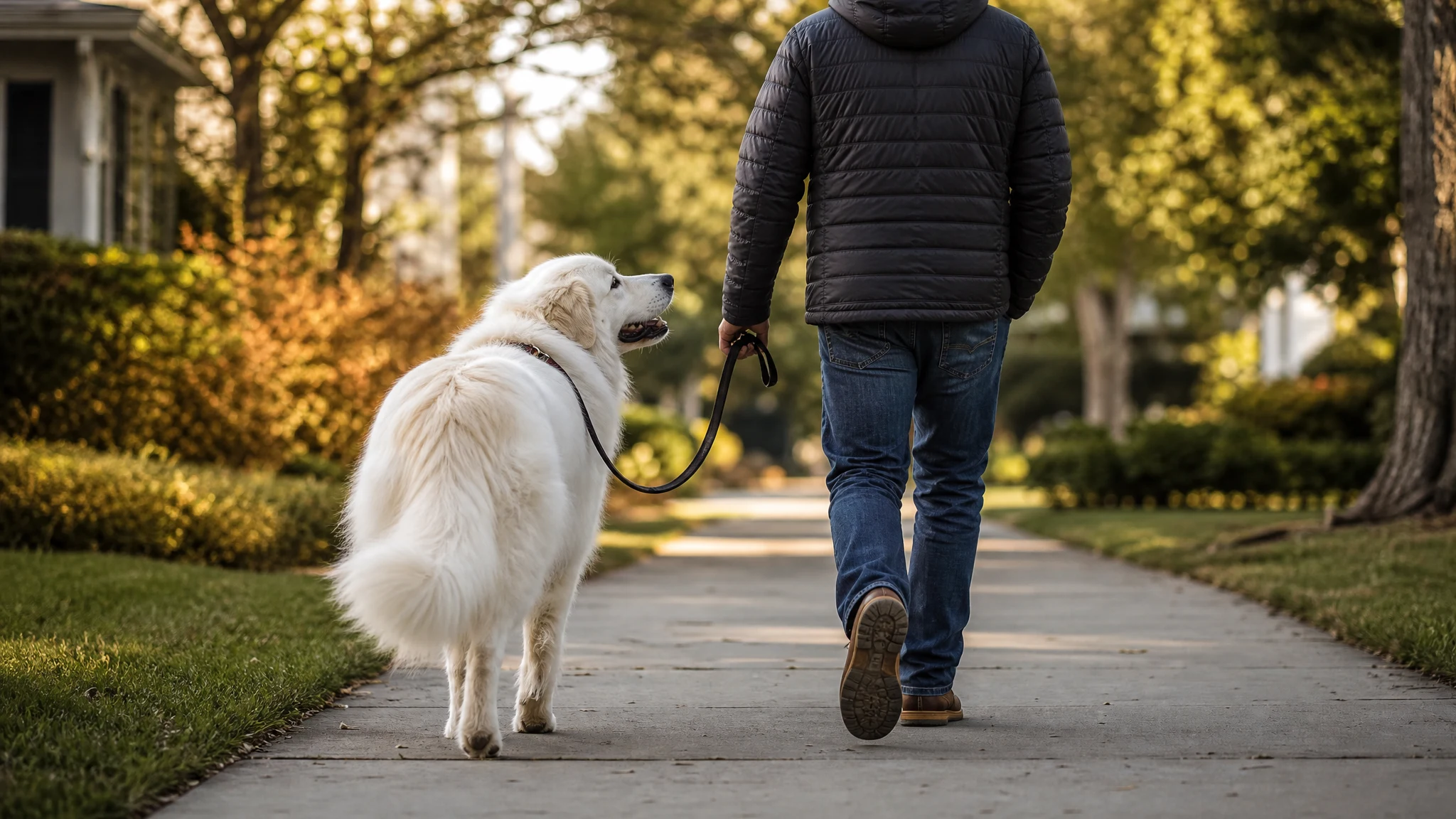
A Great Pyrenees on a leash is a lesson in physics. Males are big dogs, and when one decides a smell, a squirrel or a distant noise deserves a closer look, you feel it in your shoulder.
The good news is that loose-leash walking can be taught with patience and a pocket full of rewards. This guide covers why the breed pulls, what gear helps, a step-by-step plan, and what to do about lunging. If you want the wider picture first, start with our complete guide to training a Great Pyrenees.
Why a Great Pyrenees Pulls
Pulling is rarely stubbornness for its own sake. It usually comes from a mix of breed background and plain learning history.
According to PetMD, the breed developed in the Pyrenees Mountains between Spain and France to guard livestock. Hill's Pet describes the original job as guarding livestock from predators on mountain pastures. A dog bred for that work was meant to think for itself, patrol and notice things.
That background shows up in a few ways that matter on walks:
- Independence. The Great Pyrenees Club of America, as quoted by PetMD, describes the temperament as calm, independent and alert. Hill's rates trainability at 2 on a 1 to 5 scale (somewhat difficult). An independent dog may not care much about staying next to you unless you make that worthwhile.
- A tendency to roam. Hill's notes that the breed tends to roam and needs secure fencing. A dog that likes to range may treat the leash as an obstacle.
- Alertness. Hill's rates barking at 3 out of 5 (moderately vocal). A dog that is tuned in to its surroundings will often want to move toward whatever it notices.
Add the simple fact that pulling works. Every time a dog leans into the harness and the walk moves forward, the dog learns that leaning pays. Individual dogs vary, so treat these traits as tendencies, not rules.
Materials You Will Need
- A flat collar with ID tags, or a well-fitted front-clip harness. Either can work for a calm, reward-based approach.
- A front-clip harness if your dog pulls hard. The leash attaches at the chest, which turns the dog sideways when it surges forward instead of letting it plow ahead.
- A standard 4 to 6 foot leash. Skip retractable leashes. They teach a dog that tension means more room, which is the opposite of what you want.
- Small, soft treats that your dog values. Pea-sized pieces let you reward often without overfeeding.
- A treat pouch or pocket so rewards are fast to reach.
- A quiet practice area such as a fenced yard, driveway or empty cul-de-sac.
Gear to leave out
Do not use prong, choke or shock collars. The American Veterinary Society of Animal Behavior (AVSAB) supports humane, reward-based training. Pain-based tools can create fear and frustration, and they tend to make reactive behavior worse. A large, independent dog is better served by a clear plan and good rewards.
Whatever you choose, ask your veterinarian if you have concerns about fit or about your dog's neck, hips or joints.
Step-by-Step: How to Leash Train a Great Pyrenees
Work in short sessions of five to ten minutes. Practice in easy places first and move to harder ones only when your dog is succeeding.
Step 1: Make the gear a good thing
Before you walk anywhere, let your dog sniff the harness or collar and leash, then give a treat. Put the gear on, feed a few treats, and take it off. Repeat over a few days. You want the leash to predict good things.
Step 2: Teach a check-in
Stand in a quiet spot. Say your dog's name in a cheerful voice. The moment your dog looks at you, say "yes" and give a treat. Repeat many times.
This is the foundation. An independent dog that has learned that looking at you earns rewards will start doing it by choice.
Step 3: Reward the position you want
Pick a side and stick with it. Hold a treat at your hip and reward your dog for standing or sitting next to you. Then take one step. If your dog stays near you with the leash hanging in a loose "J" shape, say "yes" and treat at your leg.
Add one step at a time. Keep rewards coming at the spot where you want your dog to walk. Rewarding in front of you invites forging ahead.
Step 4: Stop when the leash goes tight
This is the core rule. When the leash tightens, stop moving. Stand still and quiet. Do not yank and do not talk.
The moment your dog eases back or looks at you and the leash goes slack, mark it with "yes," give a treat and walk on. Your dog learns that tension stops the walk and slack restarts it.
This takes patience with a big dog. Some early walks may cover only a few houses. That is normal and it is still progress.
Step 5: Use direction changes
If standing still is not enough, calmly turn and walk the other way. Say "let's go" in a friendly voice, and reward your dog when it catches up and is beside you. You are not punishing. You are showing that staying with you is how to get somewhere interesting.
Step 6: Raise the difficulty slowly
Once your dog walks nicely in the yard, try the driveway, then a quiet street, then busier places. Lengthen the gaps between treats gradually, but keep rewarding often when things get harder. If your dog starts pulling again, go back to an easier setting.
Loose-Leash Games That Help
Games keep practice fun for a dog that can lose interest in repetitive drills.
- Be a tree. Stop the instant the leash tightens. Walk when it loosens. Simple, and effective when you are consistent.
- Treat scatter. Toss a few treats on the ground away from you, then walk off in the other direction when your dog finishes. This turns your dog's nose into a tool for the lesson instead of a reason to pull.
- Find it. Drop a treat at your side and say "find it" so your dog learns that the best spot is next to you.
- Pace changes. Walk slowly, then a bit faster, then slowly again. Reward your dog for adjusting to your speed. It keeps your dog watching you.
- Sniff breaks as rewards. After a stretch of loose-leash walking, say "go sniff" and let your dog explore. Sniffing is a reward many dogs value highly, and you can use it to pay for good walking.
Handling Lunging at Triggers
Pulling toward something is one thing. Lunging, often with barking, at other dogs, people, bikes or vehicles is another. For a breed that was developed to guard and alert, this can show up as barking and surging forward when something draws attention.
Lunging can come from excitement, frustration or fear. You cannot always tell which from the outside, so focus on the response that helps in all cases: more distance and good associations.
- Find your dog's threshold. This is the distance at which your dog notices a trigger but can still take a treat and look at you. Stay at or beyond that distance.
- Pair the trigger with rewards. When your dog sees the trigger, say "yes" and feed a steady stream of treats while it is in view. When the trigger leaves, the treats stop.
- Turn away early. If your dog stiffens or starts to fixate, do a calm U-turn before it explodes. Reward when your dog follows.
- Close the distance slowly over many sessions. Only move closer when your dog is relaxed at the current distance.
- Plan your routes. Choose quiet times and wide spaces while you work on this. You are setting your dog up to succeed.
Never punish a dog for lunging or barking. It can make the dog associate the trigger with unpleasant things. If lunging is intense, if your dog has bitten or snapped, or if it seems fearful, talk with your veterinarian and consider a qualified, reward-based professional. The Great Pyrenees Club of America, as cited by PetMD, recommends obedience classes for first-time owners, and a group class can also be a good place to practice around distractions at a manageable distance.
Tips for Success
- Exercise before training. Hill's rates the breed's energy at 2 out of 5 and lists 20 to 40 minutes of activity a day. A short, easy warm-up can help your dog focus, but this is a moderate breed, so do not try to tire it out with hard running.
- Be consistent. Everyone who walks the dog should follow the same rules. If one person allows pulling, the lesson gets muddy.
- Keep rewards high value. An independent dog will often ask, "What is in it for me?" Use treats that are more interesting than the environment.
- Watch the heat. Hill's lists heat sensitivity among the breed's health concerns. Walk in the cooler parts of the day and bring water.
- Protect growing joints. Petful advises avoiding repetitive high-impact exercise, forced running and frequent jumps from vehicles in puppies. Puppies reach near adult height around 18 months, and maturity continues into the second or third year. Keep puppy walks short and relaxed.
- Ask your veterinarian about bloat. PetMD lists gastric dilatation and volvulus (bloat) among the breed's health issues. Ask your vet how to time meals and exercise for your dog.
- Keep the yard secure. Hill's notes that the breed tends to roam. Leash training does not replace a safe fence.
Common Mistakes to Avoid
- Yanking or "popping" the leash. It teaches your dog to pull against pressure and can hurt the neck.
- Using a retractable leash. It rewards pulling with more freedom.
- Letting pulling work "just this once." Occasional success keeps the habit alive.
- Training only on hard walks. Build the skill in easy places first.
- Expecting too much too soon. Hill's rates trainability at 2 out of 5. Plan on weeks to months of steady practice, not days.
- Skipping socialization. Hill's notes the breed does best with early socialization. Calm, positive exposure to new sights and sounds can make later walks easier.
- Correcting with dominance methods. Alpha rolls, scruffing and similar methods are not supported by AVSAB and can damage trust.
What Results to Expect
Every dog learns at its own pace, and no plan can promise a specific outcome. With consistent, reward-based practice, many owners find that their dog pulls less and checks in more over time. Loose-leash walking in easy settings often comes first. Walking nicely past distractions usually takes longer.
Lunging at triggers may improve gradually as your dog learns that the things it reacts to predict rewards and that you will keep it at a comfortable distance. Setbacks are normal, especially during adolescence. If progress stalls, go back a step, shorten sessions and consider help from a qualified reward-based trainer.
If your dog's behavior changes suddenly, or if pulling or lunging seems tied to discomfort, see your veterinarian before changing your training plan.